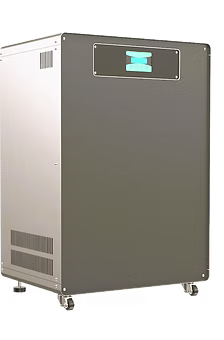
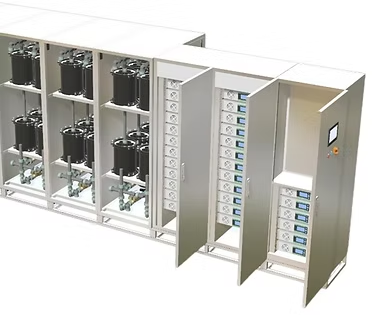
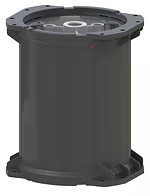
CDI (Capacitive Deionization)
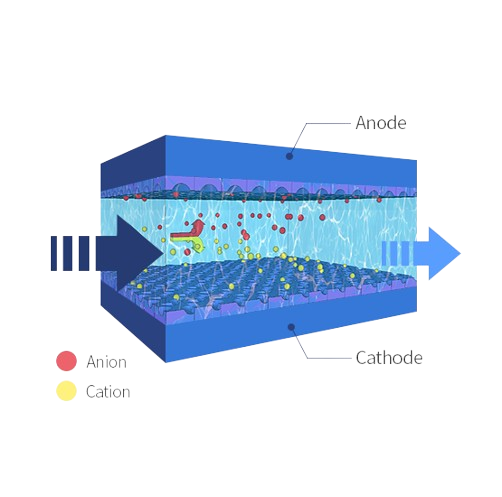
A capacitive deionization technology based on the principle that when electricity is applied to the electrodes, the oppositely charged ions pass through the ion membrane and move to the electrode surface for electric adsorption.
Features
Advantages:
When the water source is groundwater, river water or municipal water CDI is the most cost-effective and energy-efficient method of purifying water. CDI removes the dissolved charged species such as total dissolved solids (TDS), ionic impurities and inorganic contaminants.
- Applicable to a wide range of TDSs
- Operation under stable DC voltage with bipolar electrodes
- High Recovery Rate < 95%
- Desalination Rate < 95%
- Operating Temperature < 40℃
- Low energy consumption due to low pressure operation
- Salt rate < 95% (remove ionic substances such as nitrogen, potassium, chlorine, hardness, magnesium, etc.)
- Cost-effective pre-treatment process compared to other technologies
- Electrical stability is ensured due to no electrodes exposed
Point of Entry System
Logicwater’s LW400 Point of Entry system works both as a softener and water purifier to treat water coming into your house.
Regular softeners require frequent regeneration, and when doing so release chemicals into the water table. This damages the environment causes corrosion in pipelines, and damages appliances.
CDI technology provides a solution that is both environment-friendly and chemical-free.
With LW400 system the owner can decide to choose the mineral level (TDS) with the click of a button.
CDI Commercial/Industrial System
Logicwater’s CDI Commerical Series is used in many types of commercial applications, such as water ATMs, rural water purification, centralized clean and safe drinking water for schools, colleges, hospitals, railway stations, big offices, laundry, agriculture, boiler industry, wastewater treatment, beverage manufacturers, the automotive industry, sewage treatment plants, breweries, and cooling towers
CDI is capable of removing the following:
Total Dissolved Solids (TDS), principally calcium, magnesium, potassium, sodium, bicarbonates, chlorides, and sulfates.
Inorganic contaminants such as antimony, arsenic, barium, beryllium, cadmium, chromium, copper, cyanide, fluoride, lead, mercury, nitrate, nitrite, perchlorate, selenium, and thallium.
Radionuclides such as alpha and beta particles, radium, and uranium.
Disinfection byproducts such as bromate and chlorite.
Ammonia, nitrites, and nitrates.
Organic contaminants dissolved in an aqueous solution as a charged species.
CDI Module & Power Supply
Up to Nine cells can be configured in series, applicable to a wide range of TDS
Operation under stable DC voltage by using bipolar electrode (300VDC or less)
High recovery rate of up to 90%
Salt removal rate of up to 90%
Operating temperature, max. 60℃
Low energy consumption due to low current operation
Electrode is not exposed to ensure electrical safety
Compared with other processes, the pretreatment conditions are simple and the pretreatment process cost is economical.